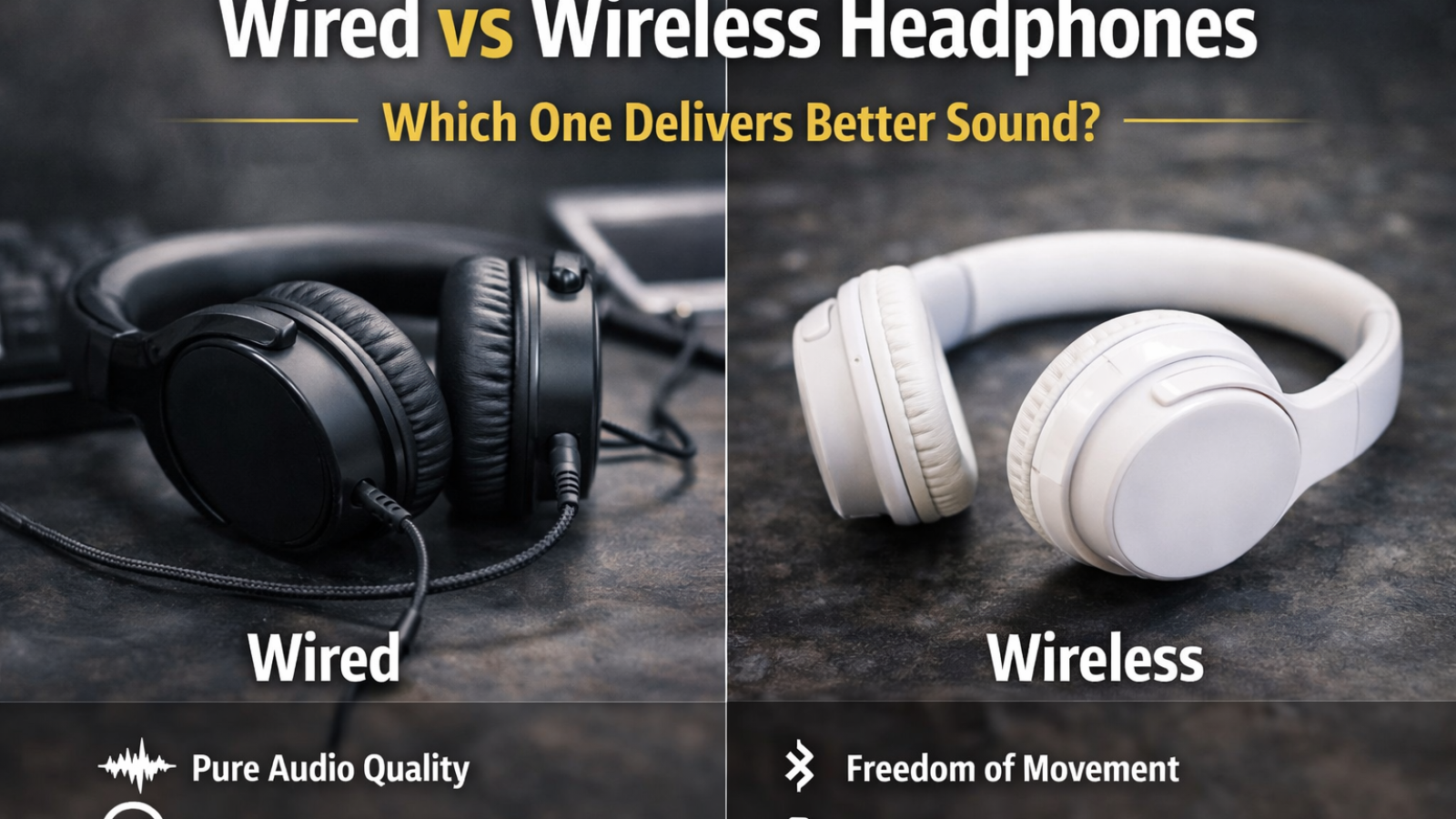
This question usually comes up right after someone buys a new phone… and realizes there’s no headphone jack.
Suddenly, the choice isn’t just about sound anymore. It becomes a mix of convenience, habit, and expectations. Some people switch to wireless instantly and never look back. Others try it for a few days and go back to wired, saying something just feels off.
So what actually delivers better sound?
The honest answer is a bit uncomfortable — it depends. But not in the vague way most comparisons say. It depends on how you listen, what you notice, and what you’re willing to compromise.
Let’s Start With the Obvious (But Often Ignored)
If we talk purely about sound quality, wired headphones still have an advantage.
There’s a simple reason behind it. Wired headphones receive audio signals directly through a cable. No compression, no transmission delay, no conversion happening in between (at least not in the same way as wireless).
Wireless headphones, on the other hand, rely on Bluetooth. And Bluetooth has limits. Audio gets compressed before it reaches your ears.
Now, for many people, this difference is not immediately noticeable. But once you pay attention — especially with high-quality tracks — small details start showing.
Vocals feel slightly less sharp, instruments lose a bit of separation. It’s subtle, not dramatic.
But Here’s Where Things Get Interesting
Most people don’t sit in a quiet room analyzing sound layers.
They’re commuting, working, walking, or just casually listening. In these situations, the difference between wired and wireless becomes less important.
Background noise, distractions, and environment often hide those fine details.
This is why many users switch to wireless and feel completely satisfied. For their usage, the convenience outweighs the slight drop in audio fidelity.
The Role of Codecs (Something Rarely Explained Properly)
If you’ve ever looked into wireless headphone specs, you’ve probably seen terms like SBC, AAC, or aptX.
These are Bluetooth codecs — basically the way audio is compressed and transmitted.
Here’s the thing: better codecs can improve wireless sound quality, but they still don’t fully match a direct wired connection.
Also, both your phone and headphones need to support the same codec. Otherwise, the benefit doesn’t really apply.
This is one of those details that sounds technical, but in real use, most people don’t check it.
Wired Headphones Feel More “Consistent”
One thing you’ll notice with wired headphones is consistency.
You plug them in, and they sound the same every time. No pairing issues, no dropouts, no battery dependency.
This reliability matters more than people expect.
Especially during long listening sessions — like editing, gaming, or watching movies — wired headphones just work without interruptions.
There’s no moment where you suddenly hear “battery low.”
Wireless Wins in Everyday Life (And It’s Not Even Close)
Now flip the situation.
You’re walking, cooking, working out, or taking calls. Suddenly, wires start feeling like a problem.
They get tangled, caught on things, or simply become inconvenient.
Wireless headphones solve this completely. That freedom of movement is something wired headphones can’t replicate.
And honestly, once someone gets used to that freedom, going back to wires can feel restrictive.
This is why wireless headphones have become so popular, even among people who care about sound.
Battery: The Trade-Off You Can’t Ignore
Wireless headphones need to be charged. That’s obvious, but the impact shows up over time.
At first, charging every couple of days feels normal. But occasionally, you’ll forget. And that’s when it becomes frustrating.
Wired headphones don’t have this problem. Ever.
This small difference becomes noticeable in daily routines. Some people don’t mind it at all. Others find it annoying enough to switch back.
Gaming and Video Watching (A Slight Edge for Wired)
If you’ve ever used wireless headphones for gaming or watching videos, you might have noticed a tiny delay.
Sometimes it’s barely noticeable. Other times, it’s enough to feel off.
Wired headphones don’t have this issue. Audio stays perfectly in sync.
For casual use, this might not matter much. But for gaming or editing work, it becomes important.
Build and Longevity
Wired headphones are usually simpler devices. Fewer electronic components, no battery, less complexity.
Because of this, they often last longer.
Wireless headphones, on the other hand, depend on batteries. And batteries degrade over time. After a couple of years, battery performance can drop noticeably.
That doesn’t mean wireless headphones are unreliable — just that they have a lifespan tied to battery health.
A Common Misunderstanding
A lot of people assume that wireless automatically means “modern” and therefore better.
That’s not always true.
Wireless is more convenient. Wired is still technically stronger in pure audio delivery.
They’re designed for different priorities
So… Which One Actually Sounds Better?
If you isolate everything — quiet environment, good audio source, proper headphones — wired headphones still deliver slightly better sound.
But in real life, the difference becomes smaller.
For most users, wireless headphones sound “good enough” and offer far more convenience.
And that’s where the decision really happens.
Final Thought (This Clears the Confusion)
Instead of asking which one is better overall, it’s easier to ask:
What matters more to you — absolute sound quality, or everyday convenience?
If you care about detail, consistency, and zero compromises in audio, wired still makes sense.
If you value freedom, portability, and ease of use, wireless is hard to beat.
And honestly, many people end up using both — wired for focused listening, wireless for everything else.
That might sound like overkill… but it’s probably the most practical answer.
Add a Comment