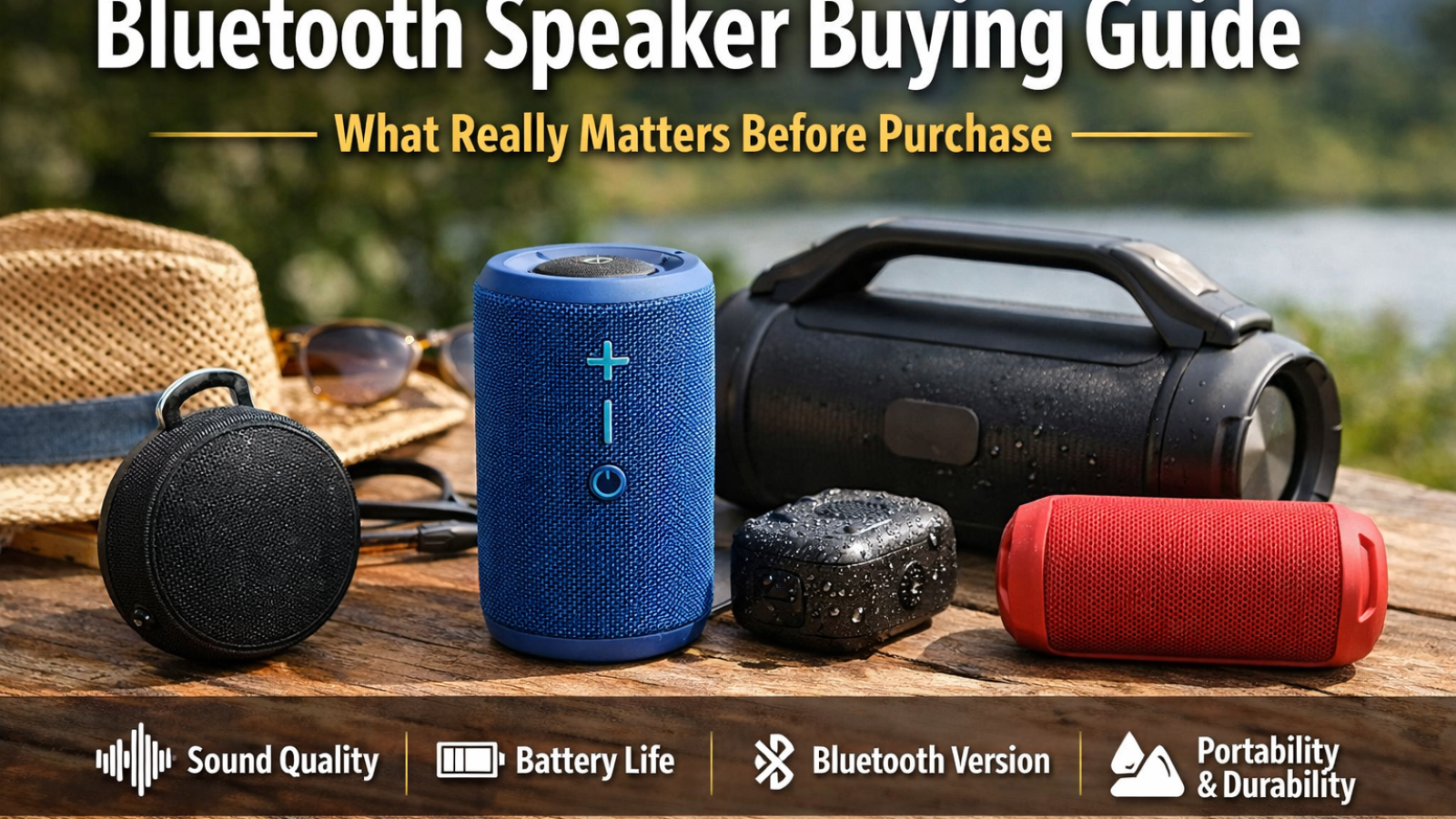
Before You Even Check Specs, Think About This
Most people don’t get confused because there are too many speakers. They get confused because every speaker looks “perfect” on paper.
You open any product page — deep bass, long battery, waterproof, premium sound. Everything sounds right. Still, after buying, something feels off.
That usually happens when the buying decision starts from specs instead of usage.
If the speaker is mostly for a room, your needs are different. If you plan to carry it outdoors, things change. Simple point, but most people skip it.
The Truth About Sound (It’s Not Just About Bass)
Here’s something you’ll notice if you’ve tried a few budget speakers — many of them push bass too hard.
At first, it feels powerful. After a while, it starts feeling messy.
Vocals lose clarity, instruments blend together. That “heavy bass” stops feeling impressive.
A better speaker usually feels balanced. Nothing feels forced.
Also, size quietly affects sound. Most compact speakers use drivers around 40–50mm. Good enough for casual use, but not always for depth.
A slightly bigger speaker often sounds noticeably fuller — even if specs don’t highlight it clearly.
Battery Life Sounds Big on Paper, But…
Those 15–20 hour claims? They’re not exactly wrong, but they’re not the full picture either.
Those tests usually happen at lower volume.
In real life, especially outdoors, volume goes up. And battery drops faster.
From practical experience, if a speaker gives around 8–10 hours comfortably, that’s already solid.
One more thing — charging type.
Micro-USB still exists, but once you start using USB-C, going back feels inconvenient.
Connection Issues: Small Detail, Big Irritation
Most people assume Bluetooth will just work.
And yes, mostly it does. Until it doesn’t.
You move to another room, or there’s a wall in between — suddenly audio cuts or stutters. This happens more with older or cheaper speakers.
Speakers with Bluetooth 5.0 or above handle this better. It’s not something you notice instantly, but over time, it makes usage smoother.
Especially if you watch videos — even slight delay can ruin the experience.
Portability Isn’t Just About Size
“Portable” means different things to different people.
For some, it means pocket size. For others, carrying it in a backpack is fine.
The mistake happens when expectations don’t match reality.
People buy ultra-small speakers expecting room-filling sound. Or they buy bigger ones and stop using them because carrying becomes a task.
There’s no perfect size — only what fits your routine.
Outdoor Use? Then Build Matters More Than You Think
If the speaker is staying indoors, build quality is not a big concern.
But the moment you take it outside — things change.
Water splashes, dust, accidental drops — these are real situations.
Basic water resistance (like splash protection) is often enough for most users. Full waterproofing is useful, but not always necessary.
Also, speakers with rubber edges or fabric mesh tend to survive longer than glossy plastic ones.
Looks fade. Durability stays.
Features That Sound Cool… But Not Always Needed
Brands love listing features.
Built-in mic, multi-device pairing, stereo mode — all good additions.
But not everything matters to everyone.
Stereo pairing is one feature that can genuinely improve experience, but only if you plan to use two speakers.
Otherwise, it’s just another spec on the box.
Where Most People Go Wrong
Some buying mistakes repeat again and again.
Going for the cheapest option is one of them.
It works for a few days, then compromises start showing.
Another is trusting marketing words blindly.
“Extra bass” doesn’t mean good sound. It just means louder bass.
And then there’s the volume obsession.
Louder is not always better. Clean sound at moderate volume often feels better long-term.
Final Thought (This Simplifies Everything)
At the end, choosing a Bluetooth speaker is not about finding the “best” one. It’s about finding the one that fits your usage.
If the sound feels natural, battery lasts through your day, connection stays stable, and the build matches how you use it — that’s enough.
Add a Comment